


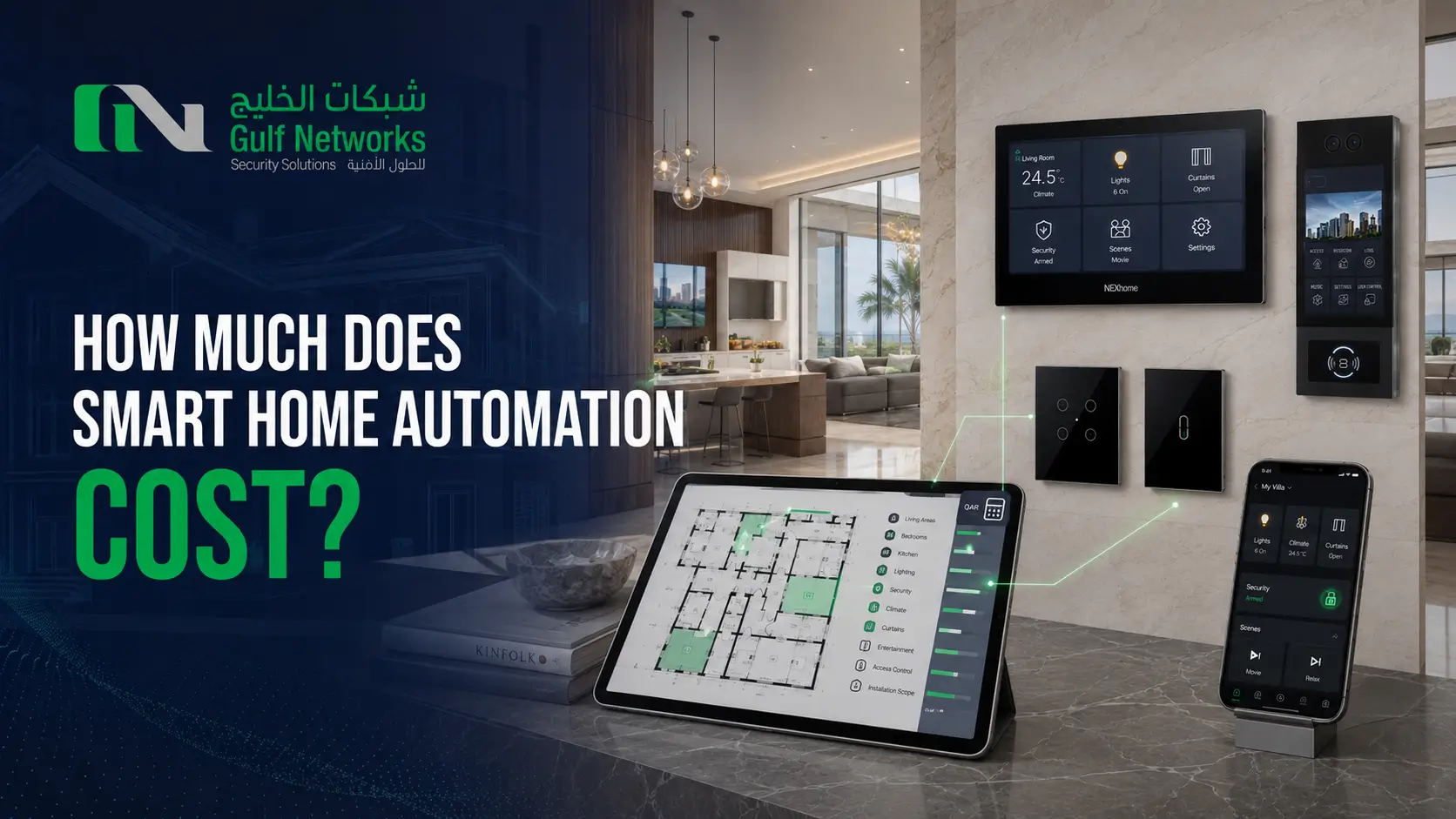
One of the first questions homeowners ask when planning a connected villa is: how much does smart home automation cost?
There is no single price that applies to every property. The final investment depends on the size of the villa, number of rooms, systems being automated, existing wiring, selected technology and whether the project is a new build or retrofit.
A professionally planned smart home automation system can range from essential lighting and climate control to a fully integrated villa solution.
A small project covering lighting and mobile control will naturally cost less than a complete villa automation system integrating lighting, air conditioning, motorized curtains, CCTV, video intercom, access control and smart locks.
This guide explains the main factors that determine smart home automation cost and how villa owners in Qatar can plan a realistic automation budget.
The biggest pricing factors are usually:
Two villas of similar size can therefore have very different automation budgets.
Property size has a major influence on the total project scope.
A larger villa normally requires more:
The number of rooms alone does not determine the final cost, but it provides a useful starting point when defining the project.
Lighting is one of the most common components of a smart-home project.
Pricing depends on the number of lighting circuits being controlled and whether functions such as dimming and scene control are required.
Typical automation may include:
A villa with extensive decorative lighting and many independently controlled circuits will require a larger system than a property with simpler lighting requirements.
Air-conditioning control is especially relevant for villas in Qatar.
Smart-home integration can allow compatible AC systems to be managed through wall panels, schedules and mobile applications.
The cost depends on:
For new-build projects, planning AC integration during the MEP stage can simplify implementation.
For existing villas, compatibility should be checked during a site survey.
Curtain automation costs depend on both the automation controls and the physical curtain system.
Important factors include:
Motorized curtains can operate independently or become part of larger scenes.
For example, activating Movie Mode could close selected curtains, dim the lights and adjust the room environment automatically.
Smart-home projects can also integrate security systems such as:
Security integration can increase the overall project scope, but it also allows homeowners to manage more functions from a coordinated environment.
GNSS works across smart-home, CCTV and low-voltage integration, allowing these systems to be planned together instead of as completely separate installations.
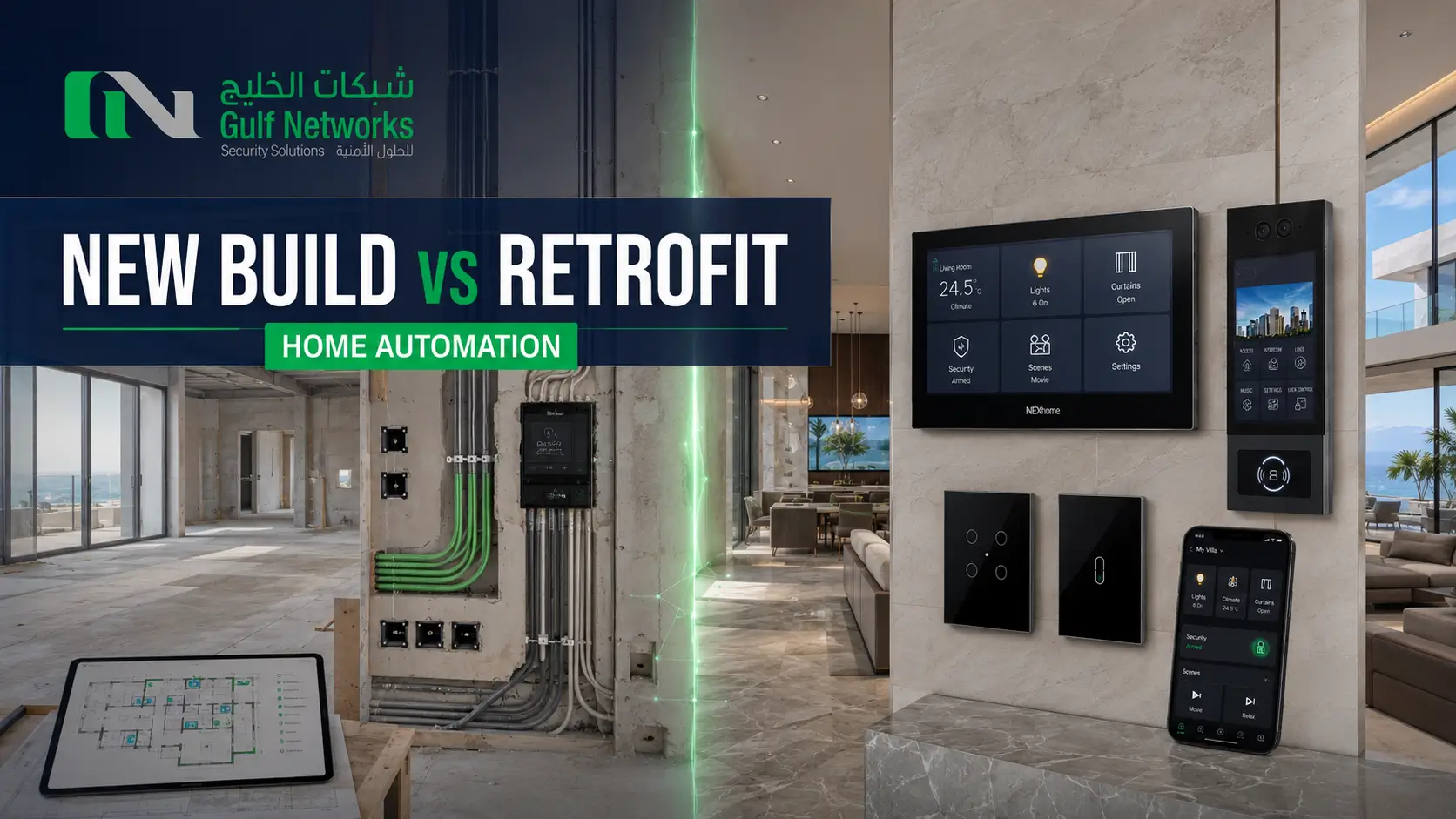
Whether the villa is under construction or already completed can significantly affect installation requirements.
During construction, the required electrical and network infrastructure can be planned before walls and ceilings are completed.
This provides greater flexibility for:
Existing villas require the automation system to work around current wiring and finished interiors.
Wireless or hybrid solutions can often reduce the amount of modification required.
However, the actual cost depends on the existing electrical system and what the homeowner wants to integrate.
For a detailed comparison, read our new build vs retrofit home automation guide.
There is no universal rule that wired systems are always more expensive or wireless systems are always cheaper.
Costs may include:
Wired systems are particularly practical when planned during construction.
Wireless technology can reduce certain cabling requirements and is often useful for retrofit projects.
However, the final cost still depends on the number and type of devices installed.
Many villas benefit from a combination of both.
The objective should be to select the architecture that suits the property rather than simply choosing whichever technology appears cheaper initially.
Calculating smart-home automation strictly “per room” can be misleading.
A bedroom may only require lighting and AC control, while a majlis or living room could include:
Similarly, security systems, network infrastructure and centralized controllers serve the entire property rather than one specific room.
For this reason, a full project scope provides a more accurate estimate than a simple per-room calculation.
A useful way to think about cost is by scope, rather than by one fixed package price.
Typically focuses on:
This may suit homeowners who want to automate key daily functions first.
May include:
Can include:
A complete integrated villa therefore represents a very different project from installing a few smart switches.
Searching online often reveals inexpensive individual devices or bundled smart-home packages.
These prices can be useful when comparing individual products, but they do not necessarily represent the cost of a professionally integrated villa.
A complete project may include:
For this reason, comparing only headline product prices may not provide an accurate picture of the complete cost of a professionally installed smart home system.
For villas in Qatar, automation projects often place particular emphasis on:
The final home automation cost in Qatar depends on how many of these systems need to be integrated, the size of the villa and the existing condition of the property.
For new-build villas, early planning with the electrical, MEP and network teams can help avoid unnecessary later modifications.
For existing villas, a site survey is especially important because the automation design needs to work around existing wiring and interior finishes.
The overall villa automation cost can therefore vary considerably from one project to another.
The most reliable quotation should be based on actual project requirements rather than a generic package.
Before requesting a quote, consider:
A site survey or review of project drawings can then help determine the correct system architecture and provide a more accurate estimate of the smart home installation cost.
The value of home automation should not be measured only by the number of devices installed.
A well-designed system can improve:
The key is to invest in the functions that provide genuine value for the people using the property.
Gulf Networks Security Solutions provides smart-home and integrated low-voltage solutions for villas and residential properties in Qatar.
Depending on the project, GNSS can support:
For a complete overview of villa automation, read our smart villa automation guide.
You can also explore our smart home automation solutions for villas and residential properties in Qatar.
Smart home automation cost depends on property size, number of devices, systems being integrated, installation requirements and whether the project is a new build or retrofit.
Generally, larger villas require more switches, sensors, controllers, AC integrations and other devices, so the project scope is usually larger.
Not necessarily. Retrofit costs depend on the existing infrastructure and required modifications. Wireless and hybrid technologies can sometimes reduce additional cabling requirements.
Yes, provided the system architecture and selected technology support future expansion. Planning for scalability from the beginning is recommended.
This depends on the supplier and quotation. A professional proposal should clearly identify equipment, installation, programming, testing and any other included services.
Yes. The most accurate quotation is based on the villa layout, project stage, required integrations and automation scope.

DISCUSS YOUR PROJECT
GNSS can assess your villa requirements and recommend a smart home solution based on the property size, required systems, installation method and future expansion plans.
Sign up today for hints, tips & the latest product news
 Optimized by Seraphinite Accelerator